 <\/div>
<\/div>
<\/div>
Firmus and Nvidia: A New Step in the Global "AI Factory" Construction Race
Keywords:<\/strong>Nvidia, Firmus, AI factory, GPU, DGX Cloud Lepton, CoreWeave, AI infrastructure, Batam, Indonesia, NVentures<\/p>
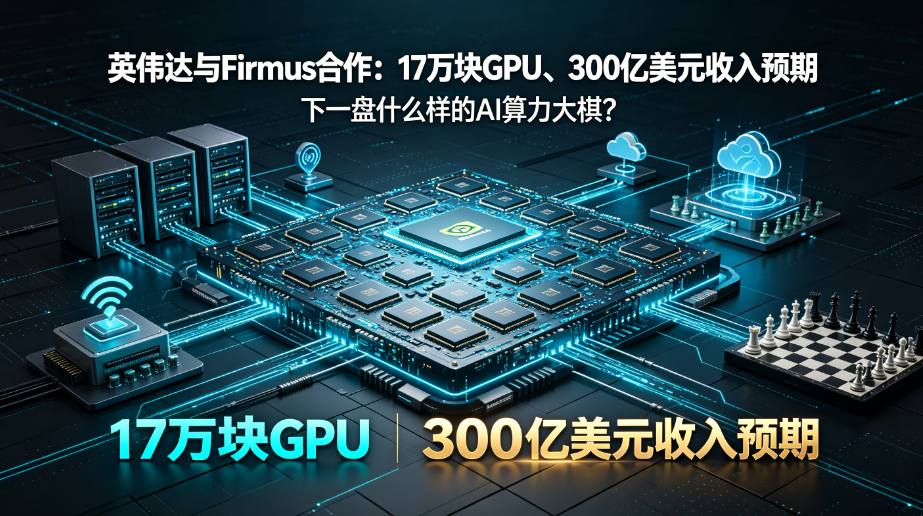
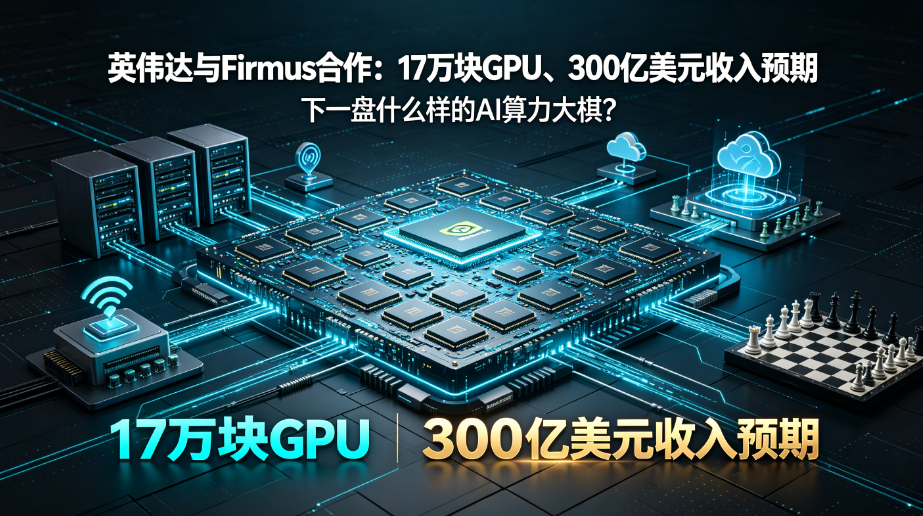
The AI infrastructure market is clearly entering an industrialization phase. GPUs are no longer just hardware sold to big tech companies but are becoming the "fuel" of a new computing economy. Against this backdrop, the latest news about Firmus and Nvidia has attracted particular attention: the two signed a strategic cooperation agreement to deploy 170,000 GPUs in Batam, Indonesia, between Q1 2027 and early 2028, building a massive "AI factory."<\/p>
This is not just a hardware supply deal but also a clearer reflection of Nvidia redefining its role: from chip maker to builder of the entire AI ecosystem, encompassing capital, platforms, operational partners, and a global customer network.<\/p>
Founded in 2019, Firmus initially engaged in Bitcoin mining before pivoting to operate energy-efficient AI data centers. This transition is not accidental. Many companies originating from cryptocurrency mining have accumulated three important advantages: power infrastructure, GPU management capabilities, and experience in optimizing operating costs for high-intensity computing loads.<\/p>
It is reported that Firmus has hired investment banks to prepare for an IPO. This indicates the company is trying to shift from a project operation model to a larger-scale capital expansion model. More notably, Nvidia began investing in Firmus in 2024 and continued injecting capital over the next two years, raising the company's valuation to about $5.5 billion.<\/p>
For AI infrastructure companies, value lies not only in how many GPUs they have but also in the ability to sign long-term contracts, optimize energy consumption, ensure network latency, and maintain high resource utilization. Firmus is striving to prove it can be an important link in the AI supply chain outside the US.<\/p>
According to the agreement, Nvidia and Firmus will deploy 170,000 GPUs in Batam, Indonesia, between Q1 2027 and early 2028. This scale indicates that the project is not simply expanding a data center cluster but building a supercomputing cluster capable of supporting AI training and inference at an industrial scale.<\/p>
Batam, close to Singapore, is a hub for data transit and international network connections in Southeast Asia. It is suitable for building large data centers because it can leverage regional infrastructure while avoiding fierce competition for land and power capacity in mature markets.<\/p>
Firmus said that based on customer commitments, the project's expected revenue could reach $30 billion, while also generating product revenue for Nvidia. This figure reflects an important reality: the economic value of AI is shifting from software to the infrastructure layer, where control over GPUs, networks, cooling, and energy determines the ability to serve the market.<\/p>
Nvidia's investment structure in Firmus is considered very similar to CoreWeave, which has become a typical case in the current AI infrastructure wave.<\/p>
CoreWeave was founded in 2017, initially as an Ethereum mining company. After the "crypto winter" of 2018, the company used its accumulated GPUs to pivot to renting computing power to AI enterprises. In 2023, Nvidia first invested $100 million in CoreWeave while signing a $1.3 billion long-term chip supply agreement. In subsequent years, Nvidia continued to increase its stake; currently it holds over 47 million shares, about 11%.<\/p>
In March 2025, CoreWeave listed on Nasdaq, raising $1.5 billion and becoming one of the largest AI IPOs in the US since 2021. The company currently has a market cap of about $52.7 billion.<\/p>
The commonality between CoreWeave and Firmus is that both started in the traditional computing infrastructure space before pivoting to offer "GPU as a service" for AI. Nvidia not only sells them chips but also provides capital investment, guarantees supply, and helps them accelerate expansion. This model generates hardware revenue while nurturing strategic customers.<\/p>
Before 2023, about 90% of Nvidia's revenue came from selling hardware to cloud giants like Microsoft, Amazon, and Google. This model brought strong growth but also carried risks: large customers have the incentive to design their own AI chips to reduce dependence on Nvidia, potentially compressing order sizes over the long term.<\/p>
To address this, Nvidia began building an AI ecosystem independent of traditional cloud giants. In 2023, the company launched DGX Cloud, but this model soon created channel conflicts by directly competing with AWS and Azure. Nvidia then adjusted course, reducing the direct commercialization role of DGX Cloud and focusing more on internal R&D.<\/p>
By May 2025, Nvidia relaunched the strategy through DGX Cloud Lepton—a platform connecting global developers with GPU computing power. It is a "unified marketplace" for computing resources, where infrastructure providers like CoreWeave, Firmus, and Foxconn can connect tens of thousands of Blackwell GPUs to the platform and distribute them to customers.<\/p>
More importantly, Nvidia not only sells chips but also establishes a demand distribution mechanism. When a platform like Lepton is formed, Nvidia can control both supply and demand in the AI value chain, reducing the risk of dependence on a few ultra-large customers.<\/p>
Nvidia's ecosystem building strategy is structured into three clear layers.<\/p>
The first layer is NVIDIA Inception<\/strong>, supporting startups through resources, connections, and brand credibility. This is the incubation layer of the ecosystem.<\/p>
The second layer is NVentures<\/strong>, Nvidia's venture capital fund, focusing on investing in early-stage companies. As of May 2026, NVentures had only 2 members but had invested in 79 companies and cultivated 20 unicorns. The lean team size and remarkable results show that Nvidia is using capital as a strategic tool, not just a financial activity.<\/p>
The third layer is the Corporate Development division<\/strong>, responsible for large investments and M&A. This layer decides which companies will become core parts of Nvidia's AI network.<\/p>
With this three-layer mechanism, Nvidia has expanded its influence across many fields: foundation models, cloud and infrastructure, developer tools, robotics, autonomous vehicles, and even quantum computing and biotechnology. Investments in companies like OpenAI, Anthropic, and optics-related firms Lumentum and Corning show that Nvidia is locking in both upstream and downstream of the AI supply chain.<\/p>
The deal with Firmus shows that Nvidia is not just selling GPUs but building a closed-loop AI economy that links chips, capital, platforms, and operational partners into a unified structure. If CoreWeave was the first proof of this model's effectiveness, then Firmus is the version extending it to the Asia-Pacific region, where demand for AI infrastructure is growing strongly.<\/p>
In the AI era, whoever controls computing power controls the speed of innovation. Nvidia knows this well, and its investments in companies like Firmus show that Nvidia is moving beyond chip sales to build the complete "AI factory" of the future.<\/p>Opening<\/h2>
Firmus: From Bitcoin Mining to Energy-Efficient AI Infrastructure<\/h2>
170,000 GPUs and Batam's "AI Factory" Ambition<\/h2>
Nvidia's Repeat Pattern: The CoreWeave Case<\/h2>
What is Nvidia Building?<\/h2>
Nvidia's Three-Layer Toolkit for Expanding Influence<\/h2>
Conclusion<\/h2>